
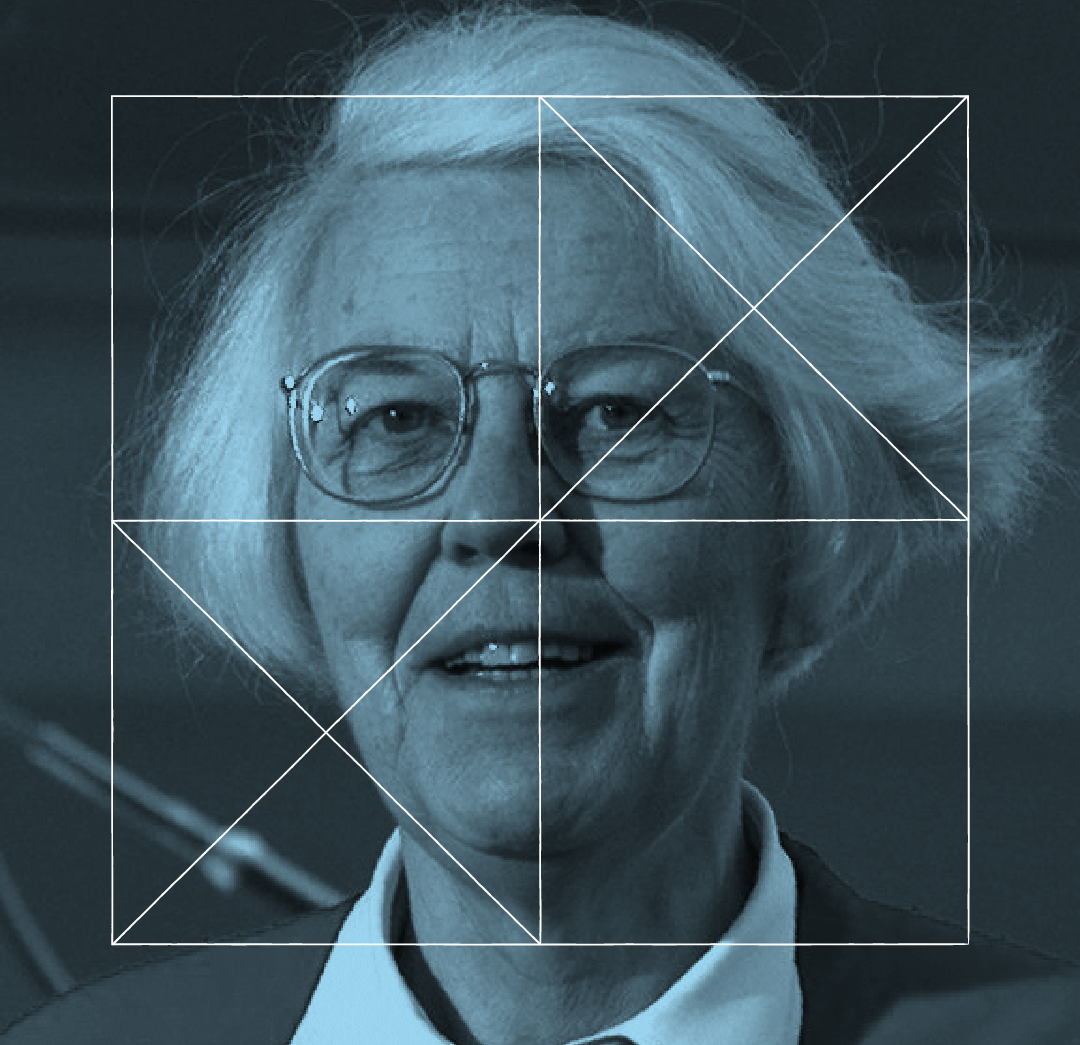
KAREN SPÄRCK JONES
THE ORIGIN STORY
Born in Huddersfield in 1935 to a Norwegian mother and British father, Karen’s early life was marked by curiosity and independence. She studied history at Cambridge, became an educator and then jumped head-first into computing - inspired by Margaret Masterman at the Cambridge Language Research Unit.
Her first challenge: teaching computers to truly understand language. To understand ambiguous words, like field, across contexts. This led her to program a massive thesaurus, the beginnings of Natural Language Processing (NLP) as we know it today.
By the 1970s, she had formalised Inverse Document Frequency and index-term weighting, laying the groundwork for search engines decades before they became essential to modern life.
THE BUILDER
Karen didn’t stop at theory: she shaped the infrastructure of computing itself.
1964: Published Synonymy and Semantic Classification, foundational to NLP.
1972: Introduced IDF in the Journal of Documentation, foreshadowing Google.
1980s: Contributed to early speech recognition systems.
1993: Co-authored Evaluating Natural Language Processing Systems, a seminal textbook.
1999: Became Professor of Computers and Information at Cambridge.
BCS Lovelace Medal (2007): First woman to win it, recognising her transformative work.
She also worked on the Alvey Program, supporting UK research in knowledge engineering, and mentored generations of researchers. Her principles still underpin AI and search today.
REFLECTIVE THINKER
Karen was more than her algorithms: she cared about ethics, context, and social impact.
Computing is deeply embedded in everyday life, from healthcare to transportation to identity systems.
Professionals must consider not just can we do it?, but should we?
Women bring essential perspectives — thoughtful, socially aware, and less inclined to blindly pursue technical fixes.
Even routine tasks, like spreadsheets or search engines, require deep understanding of social context.
“As computing is spreading so far into people’s lives, you need to think about these things.”
Her life combined rigour, curiosity, humour, and humanity — from restoring vintage sailboats with her husband, Roger Needham, to mentoring students while keeping a personal library overflowing with books and art.
THE LEGACY
Karen Spärck Jones built the intellectual architecture for modern search and AI. Her work shows:
How computers can understand humans, not just execute commands.
Why ethics and social responsibility are inseparable from technical skill.
That women’s perspectives are essential in shaping the tools that shape society.